




Bass Traps: What They Do, Corner Placement & How Many You Need
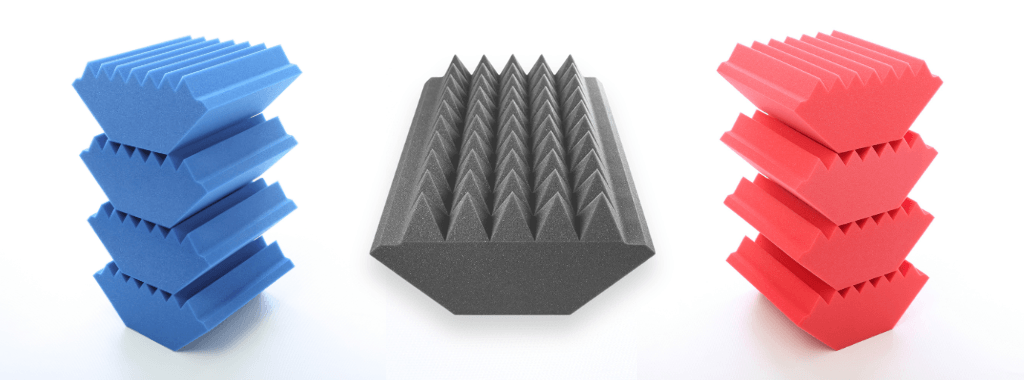
Bass traps are thick acoustic foam absorbers that sit in the corners of a room to soak up low frequency sound, the boom and muddiness that thin wall tiles cannot reach. Bass builds up in corners because that is where sound pressure from room resonances peaks, so a corner is where a trap does the most work. At GB Foam Direct in High Wycombe we make wedge and pyramid bass traps and corner cubes in house, alongside acoustic tiles and room kits.
Key takeaways
- A 100 Hz sound wave is about 3.4 metres long, which is why bass needs much thicker absorbers than speech or treble.
- Porous absorbers such as foam work best when their depth is about a quarter of the wavelength, so corners and air gaps matter more than tile thickness alone.
- A rectangular room has 12 corners where two surfaces meet and 8 tri-corners where three meet; start with the 4 floor to ceiling corners.
- Use at least 4 traps, one in each floor to ceiling corner; adding the 4 wall to ceiling corners takes a room to 8 to 12 traps.
- GB Foam Direct bass traps are rated NRC 0.85 and come in packs of 4, 8, 12 and 24, with large 600mm wedge and pyramid traps sold in pairs.
- GB Foam Direct has made foam in High Wycombe since 1976, works to ISO 9001 and gives a 5 year guarantee against faults in manufacture.
What Do Bass Traps Do?
Bass traps absorb low frequency sound energy so that bass notes stop booming, ringing on and masking the detail in music, speech and game audio.
Every enclosed room has resonant frequencies, called room modes, set by its length, width and height. At these frequencies sound waves reinforce each other and some bass notes sound far louder than others, while others almost vanish. These peaks and dips are most noticeable at low frequencies, where the wavelengths are similar in size to the room itself.
Why Does Bass Build Up in Room Corners?
Bass builds up in corners because sound pressure from room modes is always at its highest where walls meet.
The Institute of Sound and Vibration Research at the University of Southampton explains that at a hard wall the air cannot move, so the pressure is at a maximum. Where two or three walls meet, those maxima stack up, and Penn State University acoustics teaching material notes that in a hard walled room the pressure is always greatest at the walls or in a corner.
A trap in a corner therefore sits in the zone of highest pressure for almost every room mode.
How Thick Do Bass Traps Need to Be?
Bass traps need to be much thicker than acoustic tiles, because a porous absorber works best when its depth is around a quarter of the wavelength it is absorbing.
Using the speed of sound at about 343 metres per second, the table shows why a 50mm wall tile cannot control bass on its own.
| Frequency | What You Hear | Wavelength | Quarter Wavelength |
|---|---|---|---|
| 50 Hz | Deep bass, kick drum thump | About 6.9m | About 1.7m |
| 100 Hz | Bass guitar, male voice body | About 3.4m | About 86cm |
| 250 Hz | Low mids, boxy or muddy sound | About 1.4m | About 34cm |
| 1,000 Hz | Speech clarity | About 34cm | About 8.6cm |
A 50 Hz note would need foam about 1.7 metres deep to absorb it fully, which is not practical in any room. Corner traps get round this in two ways. The air gap behind a corner trap moves its front face further from the walls, closer to where the air is moving fastest, and stacked or larger traps add more material in the corners where bass pressure is highest. Our large pyramid acoustic foam bass traps stand 600mm high and have a straight cut back designed to leave that air gap behind the absorber.
For the theory of high and low frequencies in more depth, see our guide to everything you need to know about acoustic foam.
Where Should Bass Traps Go?
Bass traps should go in the floor to ceiling corners first, then along the wall to ceiling corners, and finally in the tri-corners where three surfaces meet.
Each kind of corner treats a different set of room modes, in the order below.
| Corner Type | Number in a Rectangular Room | What It Treats | Priority |
|---|---|---|---|
| Vertical, wall to wall | 4 | Length and width modes, plus some height modes when stacked floor to ceiling | First |
| Wall to ceiling | 4 | Height modes and the modes along each wall | Second |
| Tri-corner, wall to wall to ceiling or floor | 8 | All three dimensions at once | Third, or alongside the first two |
| Wall to floor | 4 | Same modes as wall to ceiling | Where ceiling corners are not practical |
Treat all four vertical corners before moving to the wall to ceiling corners, because the vertical corners cover modes along both the length and the width of the room. Floor level tri-corners are often blocked by furniture, so most people treat the four upper ones.
Where horizontal and vertical traps meet, a gap is left in the very corner. Our acoustic foam corner cubes are 300mm cubes chamfered to fill that point, and they are designed to be used with bass traps rather than on their own.
How Many Bass Traps Does a Room Need?
Most rooms need at least 4 bass traps, one in each vertical corner, and small studios and listening rooms benefit from 8 to 12.
Two traps in the front corners help a little, but four, one in each vertical corner, is the practical minimum. Adding traps along the 4 wall to ceiling corners brings the total to 8 to 12, which suits small studios, home cinemas and listening rooms.
Which Bass Trap Setup Should You Choose?
Choose your setup from the room’s use and size, starting with the vertical corners and adding traps from there.
| Room | Recommended Setup | Why |
|---|---|---|
| Home office or podcast corner | 4 bass traps in the two corners behind and beside the desk, plus wall tiles | Speech sits mostly above the bass range, so tiles do most of the work |
| Vocal booth or small recording room | Traps in all 4 vertical corners plus tiles | Small rooms have closely packed modes that make voices sound boxy |
| Home studio or mixing room | 8 to 12 traps across vertical and wall to ceiling corners, corner cubes at the joins | Accurate bass is needed to make mixing decisions |
| Home cinema or gaming room | Large 600mm wedge or pyramid traps stacked in the front corners first, then the rear | Subwoofers drive the lowest modes hardest |
| Drum or rehearsal room | Stacked large traps in every vertical corner, plus wall to ceiling traps | High bass energy needs as much corner absorption as the room allows |
Our room kits pair 300mm x 300mm x 50mm acoustic tiles with matching bass traps, from 24 tiles with 4 traps up to 72 tiles with 16 traps.
How to Fit Acoustic Foam Bass Traps
Fitting bass traps takes about an hour for a typical room: plan the corners, prepare the walls, then fix the traps from the floor up.
Map the corners. Count the vertical, wall to ceiling and tri-corners in the room and mark which ones are free of furniture, doors and windows.
Prioritise the vertical corners. Plan a trap or a stack of traps for each floor to ceiling corner before adding any wall to ceiling traps.
Clean the wall surfaces. Wipe each corner free of dust and grease so the adhesive bonds properly.
Test fit each trap. Offer each trap into its corner and check it sits flush on both walls before applying any adhesive.
Fix the traps from the bottom up. Apply spray adhesive suitable for foam to the two contact faces and press each trap into place, stacking upwards so each one supports the next.
Add corner cubes at the joins. Fit a corner cube wherever a vertical stack meets a horizontal run of traps along the ceiling.
Finish with wall tiles. Place acoustic tiles at the first reflection points on the side walls and behind the listening or recording position.
Spray adhesive is not included with our bass traps.
Mistakes to Avoid with Bass Traps
- Relying on wall tiles alone. Thin tiles control echo and flutter but do very little for bass below a few hundred hertz.
- Treating only one corner. Room modes run between opposite surfaces, so matching traps in opposite corners work better than one trap on its own.
- Expecting soundproofing. Bass traps improve how a room sounds inside; they do not stop sound passing through walls to neighbours.
- Leaving gaps at the joins. An open corner where traps meet leaves a high pressure spot untreated, which corner cubes are made to fill.
The shape of an absorber matters less than its thickness, a point we cover in does the shape of acoustic foam matter.
Why Choose GB Foam Direct?
GB Foam Direct has converted foam in High Wycombe since 1976, and our acoustic foam is made from open cell polyurethane and CNC cut in house. Our acoustic foam bass traps come in Studio Grey, Crystal Blue and Volcanic Red with a rated NRC of 0.85, so they match our tiles and corner cubes across the full acoustic foam range. We work to ISO 9001, give a 5 year guarantee against faults in manufacture, and orders placed before 11am Monday to Thursday are eligible for next working day delivery.
Speak to Our Team
If you need help working out how many bass traps your room needs, call us on 01494 441177, email sales@gbfoam.com or fill out our contact form. We are in the office from 9am to 5pm Monday to Thursday and 9am to 3pm on Friday.
Bass Traps FAQs
What do bass traps do?
Bass traps absorb low frequency sound energy in a room, which reduces booming, uneven bass and long ringing notes. They work best in corners, where sound pressure from room resonances is highest. The result is tighter, clearer bass for music, film and recording.
Where is the best place to put bass traps?
The best place to put bass traps is in the floor to ceiling corners of the room, followed by the corners where the walls meet the ceiling. Tri-corners, where two walls meet the ceiling, are also very effective. Sound pressure from room modes peaks in these corners, so traps there absorb the most bass.
How many bass traps do I need?
Most rooms need at least 4 bass traps, one in each floor to ceiling corner. Adding traps along the wall to ceiling corners brings the total to 8 to 12. Small studios and home cinemas usually benefit from more traps rather than fewer.
Do foam bass traps actually work?
Foam bass traps do work, mainly on upper bass and low midrange frequencies, where they reduce boominess and muddiness. Very deep bass needs more depth, so larger traps, stacked traps and the air gap behind a corner trap all improve performance. They should be used with wall tiles rather than on their own.
Are bass traps the same as soundproofing?
No, bass traps are acoustic treatment, not soundproofing. They improve how a room sounds by absorbing bass inside it, but they do not stop sound passing through walls, floors or doors. Blocking sound between rooms needs mass, sealing and decoupled construction instead.
Do I need corner cubes as well as bass traps?
Corner cubes are worth adding wherever a vertical stack of bass traps meets a horizontal run along the ceiling. They fill the gap left in the very corner, which is the point of highest sound pressure. GB Foam Direct corner cubes are 300mm, chamfered, and designed to be used with bass traps rather than on their own.
What is the difference between bass traps and acoustic panels?
Bass traps are much thicker than acoustic panels and are shaped to fit into corners, so they can absorb lower frequencies. Acoustic panels or tiles, such as 50mm foam tiles, mainly control echo and mid to high frequency reflections on flat walls. Most rooms need both for balanced sound.

Cameron has emerged as a key marketing expert since joining GB Foam Ltd in 2017. A graduate of the University of Winchester, with a professional background in Public Relations; he has combined his content writing and brand awareness expertise with an in-depth knowledge of foam products and foam conversion technology to enhance the company’s marketing strategies and industry presence. Cameron has led numerous marketing campaigns, in both B2B and B2C segments, to further brand recognition and open up new business avenues worldwide.