




Custom Foam Inserts – Factory Made & DIY Foam Trays
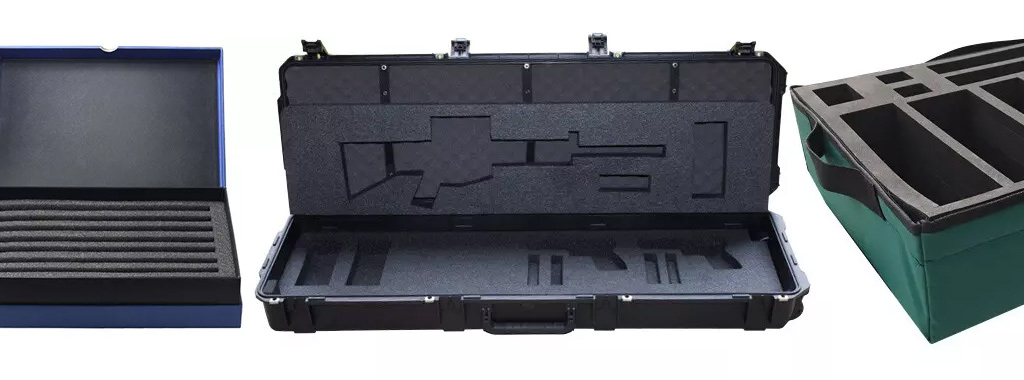
If you need to display, secure or protect items with a custom foam insert, we can supply the foam and, in many cases, cut it for you using our own factory machinery. This guide covers how factory-made and DIY foam inserts differ, which material suits which job, and how to cut your own if you’re doing it by hand.
- Factory-made inserts use die-cutting (best for larger repeat orders) or CNC routing (better suited to bespoke pieces or lower-volume runs).
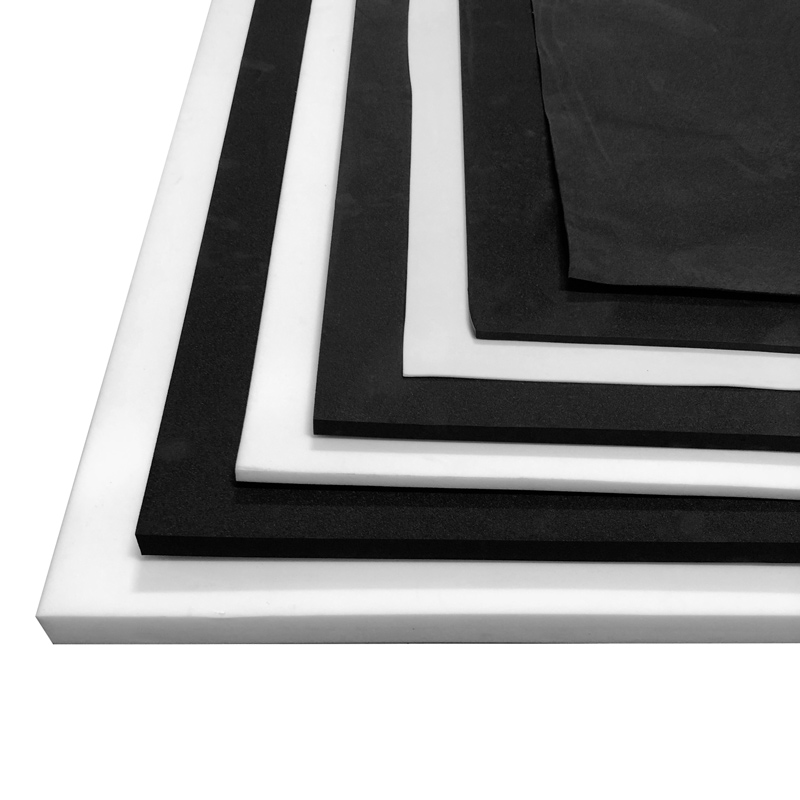
- DIY foam trays are usually cut from one of two materials: HLB packaging foam or Plastazote LD33 closed cell foam.
- HLB packaging foam is the better all-rounder for shock and impact protection. Plastazote LD33 adds water resistance and chemical resistance on top.
- Both materials are sold as flat sheets you cut down yourself: HLB in 6mm to 100mm thicknesses, Plastazote in 5mm to 50mm thicknesses.
- Shadow board tool trays are cut to your own tools or a supplied size list on our die-cutting and CNC machinery, not sold as a DIY sheet.
Why Use a Custom Foam Insert
A foam insert keeps items secure in transit or storage while also giving a case or box a more finished, premium feel. We’ve cut custom foam inserts for tool cases, technical equipment, assembly parts, electronics, presentation boxes and collectors’ items, along with promotional pieces across tech, gaming and automotive industries. If you’ve got something that needs protecting or presenting, a foam insert is usually the answer.
A shadow board tray is one of the most requested versions of this: a foam insert cut with a recess for each tool, so it’s clear where everything lives and just as clear when something’s missing.
Factory-Made Foam Inserts
We can cut precision foam inserts for you using our own factory machinery. There are two main methods, and which one suits your job depends mostly on order size and how intricate the shape is.
| Method | How it works | Best for |
|---|---|---|
| Die-cutting | A specialised press forces the foam through a shaped die, a bit like a cookie cutter, replicating the exact same cut every time. | Larger repeat orders. Setup costs mean it’s not cost-effective for one-off pieces, but once the die is made it’s fast and consistent for volume. |
| CNC routing | A CNC router machines the shape directly out of the foam block or sheet, guided by a digital file rather than a physical die. | Multiple matching trays, a single bespoke piece for something important, or intricate and irregular shapes. If you just need one tray for your own toolbox, our DIY foam below is usually the simpler route. |
Both machine types are in our factory alongside our other foam cutting equipment. If you’d like a quote or want help deciding which method fits your order, email sales@gbfoam.com or call 01494 441177.
Shadow Board & Tool Tray Foam Inserts
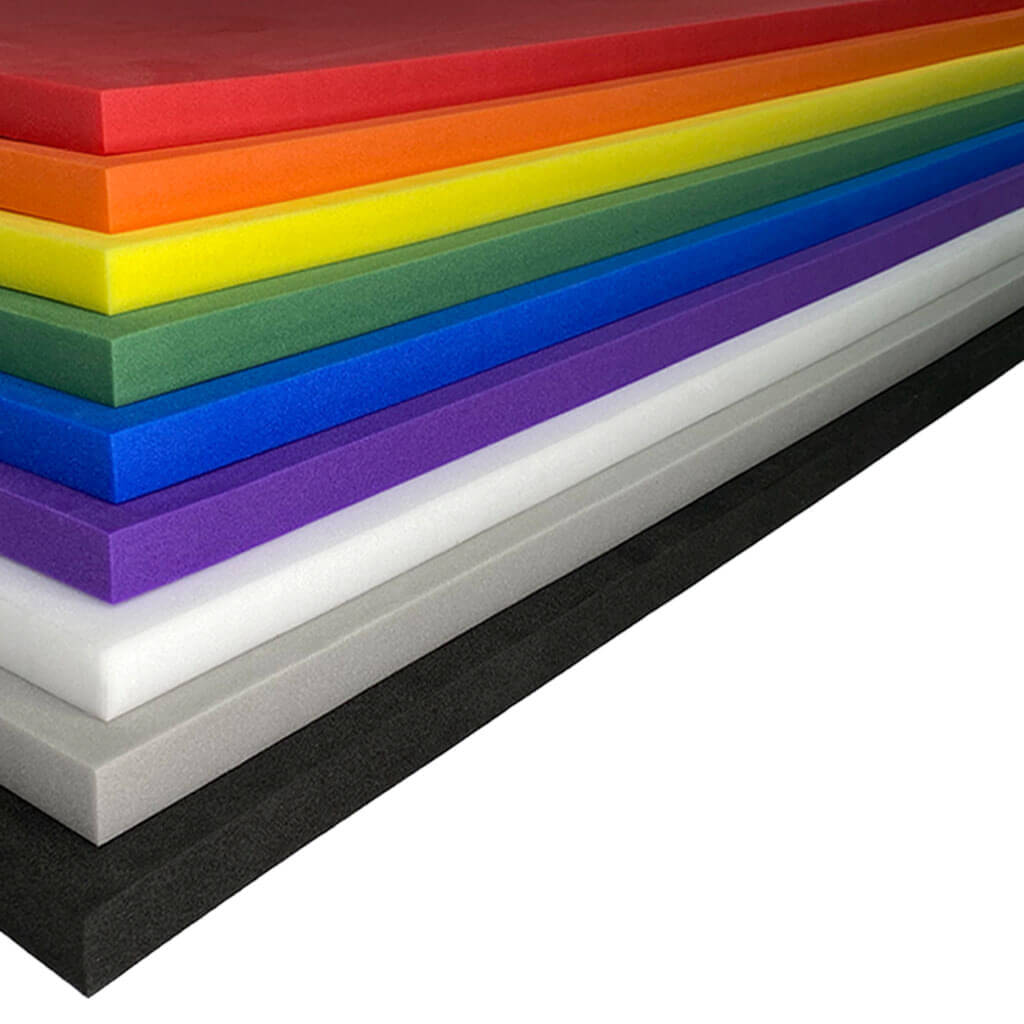
A shadow board foam insert has a recess cut for each tool, so it’s easy to see at a glance where everything goes and whether anything’s missing. We cut these from Plastazote LD33, available in nine colours including black, white, blue, green and red, using the same die-cutting and CNC routing methods covered above, with cavities shaped around sockets, wrenches and other tools, including labelled compartments by size where it’s useful.
For extra contrast, we can bond two layers of Plastazote in different colours together, then cut through just the top layer so the base colour shows through in each tool-shaped recess, a black base under a bright top colour, for example, or the other way round. It makes a missing tool stand out even more clearly than a single-colour tray.
Because they’re cut by machine rather than hand-cut from a sheet, we can match cavities to your own tools or a supplied size list, rather than working from a fixed generic layout. Larger repeat runs, such as identical trays across a fleet of vans, suit die-cutting, while a single bespoke tray for something important, or an especially irregular tool layout, tends to suit CNC routing. If you just want one tray for your own garage toolbox, cutting it yourself from a sheet of Plastazote below is usually the simpler route, though we’re happy to quote a factory-made one if you’d rather.
- Cut to match your own tools or a supplied size list, not a fixed generic layout
- Cut from Plastazote LD33, the same material covered below
- Can be layered in two colours for extra contrast between the tray and each tool recess
- Suits toolboxes, tool chests, drawer units, van racking and flight cases
- Compartments can be labelled by size or tool name where it’s useful for your team
If you’d like a shadow board tray cut for your own tools, send over your layout or a list of what needs a space and we’ll quote it.
DIY Foam Trays: Choosing Your Material
If you’re cutting your own foam insert, you’ll almost always be choosing between two materials: HLB packaging foam or Plastazote LD33 closed cell foam. Both come as flat sheets you cut down at home, but they behave differently, so the right one depends on what you’re protecting.
| Property | HLB Packaging Foam | Plastazote LD33 |
|---|---|---|
| Type | Open cell polyurethane foam | Closed cell polyethylene foam |
| Apparent density | 20 to 22 kg/m³ (BS EN ISO 845:2009) | 33 kg/m³ nominal |
| Hardness | 215 to 290 Newtons (BS EN ISO 2439 Method B) | Shore Hardness OO 58 |
| Sheet size | 230 x 100cm or 230 x 200cm | 200 x 100cm |
| Thickness range | 6mm to 100mm | 5mm to 50mm |
| Colours | Grey | 9 colours: black, white, blue, green, grey, orange, purple, red, yellow |
| Water and chemical resistance | Not water-resistant (open cell structure) | Water-resistant and resistant to a wide range of chemicals |
| Best for | General shock and impact protection where water resistance isn’t a factor | Anything that also needs to handle moisture, chemicals or UV exposure |
| From | £16.99 | £29.99 |
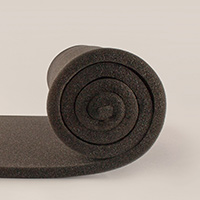
HLB packaging foam is our high load bearing polyurethane foam, built for shock and impact absorption. It’s a popular default choice for DIY inserts because it’s easy to cut and handles general knocks well. Read more on our packaging foam page.
Plastazote LD33 is a closed cell foam, which means it doesn’t absorb water the way open cell foams do. It’s also resistant to a wide range of chemicals and holds up well under UV exposure, so it’s worth the extra cost if your items will be stored somewhere damp or outdoors, or need chemical resistance. Plastazote is used well beyond packaging too, in medical, automotive and museum applications among others. Read more on our Plastazote page.
How to Cut Your Own Foam Insert
Choose your foam grade based on what you’re protecting: HLB for general shock absorption, Plastazote if you need water or chemical resistance too.
Plot out the shape you want to cut, either by drawing directly onto the foam or by placing your item on the sheet and marking around it.
Use a sharp blade, such as a scalpel or craft knife, to make clean incisions along your marked lines. Take your time on corners and curves.
Work carefully and always cut away from yourself. Sharp blades on foam can slip, so treat this the same as any other bladed task.
Expect it to take a bit of practice. A hand-cut insert won’t have the perfectly clean edges of a die-cut or CNC-routed one, but with a steady hand you’ll get a solid result.
Factory-Made or DIY: Which Should You Choose
- Choose factory-made if you need a large repeat order, a perfectly clean finish, or an intricate shape that would be difficult to cut by hand.
- Choose DIY if you need a one-off insert quickly, are working to a tight budget, or don’t mind a less polished finish.
- Not sure which fits your order? Get in touch and we’ll talk through the options based on your quantity, shape and budget.
Frequently Asked Questions
What’s the difference between die-cutting and CNC routing?
Die-cutting presses the foam through a pre-made shaped die, which makes it fast and consistent for larger repeat orders but not cost-effective for one-off pieces. CNC routing machines the shape directly from a digital file with no die needed, making it better suited to bespoke pieces, lower-volume orders or intricate shapes.
Can I cut my own foam insert at home?
Yes. Both HLB packaging foam and Plastazote LD33 can be cut at home with a sharp blade such as a scalpel. It takes some practice to get a clean finish, and you should always take care when working with sharp blades.
Should I use HLB packaging foam or Plastazote for my foam insert?
HLB packaging foam is a good general-purpose choice for shock and impact protection. Plastazote LD33 costs more but is water-resistant and resistant to a wide range of chemicals, so it’s worth choosing if your items will be exposed to moisture, chemicals or UV.
What sizes do HLB and Plastazote sheets come in?
HLB packaging foam sheets come in 230 x 100cm or 230 x 200cm, with thicknesses from 6mm to 100mm. Plastazote LD33 sheets are 200 x 100cm, with thicknesses from 5mm to 50mm.
What is a shadow board foam insert?
A shadow board foam insert is a tray with a recess cut for each tool, so it’s easy to see at a glance where everything goes and whether anything is missing. We cut these to your own tools or a supplied size list using our die-cutting and CNC routing machinery.
What’s the difference between a shadow board insert and pick and pluck foam?
Pick and pluck foam comes pre-scored into a grid of small cubes that you pull out by hand to rough out a shape, so the result varies with how it’s plucked. A shadow board insert is cut by machine to an exact layout, giving a cleaner, more consistent recess for each tool.
Can I get a two-colour shadow board insert?
Yes. We can bond two layers of Plastazote in different colours together and cut through just the top layer, so the base colour shows through in each tool recess. This gives more contrast than a single-colour tray, making it easier to spot a missing tool at a glance.
Speak to Our Team
If you’d like to know more about our custom foam insert services, or want help choosing between factory-made and DIY, get in touch. One of our foam experts will be happy to help you find the right product for your needs.

Cameron has emerged as a key marketing expert since joining GB Foam Ltd in 2017. A graduate of the University of Winchester, with a professional background in Public Relations; he has combined his content writing and brand awareness expertise with an in-depth knowledge of foam products and foam conversion technology to enhance the company’s marketing strategies and industry presence. Cameron has led numerous marketing campaigns, in both B2B and B2C segments, to further brand recognition and open up new business avenues worldwide.