




Best Glue for Foam: Spray Adhesives, Layering and Bonding to Wood
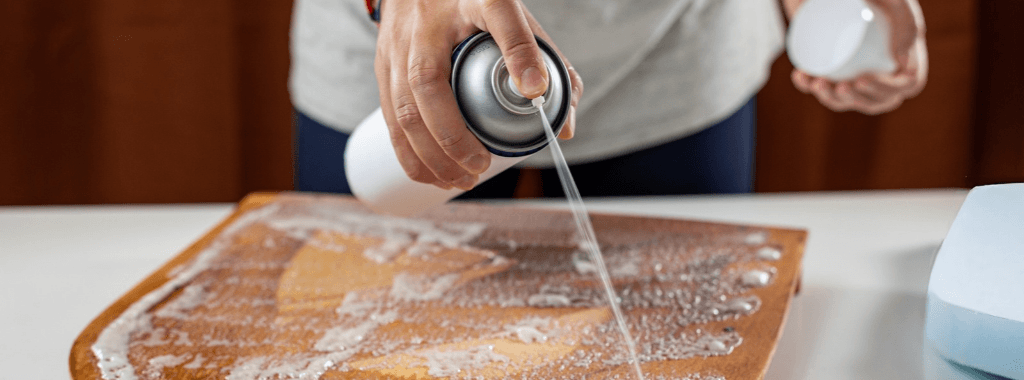
The best glue for foam is a spray contact adhesive made for upholstery, applied in a thin coat to both surfaces and pressed together once tacky. It bonds foam to wood, to fabric and to other foam while staying flexible, which hard setting glues do not. GB Foam Direct cuts foam to size and sells a Heavy Duty Spray Adhesive for bonding it, and we can laminate foam layers for you at our High Wycombe factory.
Key takeaways
- Spray contact adhesive is the standard glue for polyurethane foam because it bonds on contact and stays flexible.
- Spray a thin coat on both surfaces and wait 1 to 2 minutes until it is tacky before joining them.
- Spray adhesives work best between 15 and 25°C in a well ventilated room, according to manufacturer data.
- Avoid PVA, wood glue and super glue on cushions: they soak in or set hard and can be felt through the fabric.
- We can laminate layers such as GB 55M memory foam on a firmer base for you if you add a note at checkout.
- GB Foam Direct has cut foam in High Wycombe since 1976, works to ISO 9001 and offers next working day delivery on orders before 11am Monday to Thursday.
What Is the Best Glue for Foam?
The best glue for foam is a spray contact adhesive designed for foam and upholstery. It is sprayed onto both surfaces, left to go tacky, then pressed together to form an instant, flexible bond.
Flexibility matters because foam moves every time someone sits or lies on it. A glue that sets rigid cracks away from the foam or creates a hard ridge you can feel through the cover.
Spray adhesive also covers a large area quickly with a thin film. That keeps the foam soft and avoids the wet patches you get from brushing liquid glue into open cell foam.
Foam Glue Types Compared
Spray contact adhesive is the right foam glue for almost every cushion, seat and mattress job, while other glues suit only small or craft uses.
| Glue Type | Works on Polyurethane Foam? | Best For | Drawback |
|---|---|---|---|
| Spray contact adhesive | Yes | Seats, cushions, mattresses, layering | Needs ventilation while spraying |
| PVA or wood glue | Poorly | Paper and wood crafts | Soaks into foam and dries slowly |
| Hot glue gun | Small jobs only | Cosplay and craft pieces | Sets in hard lines |
| Super glue | Small spots only | Tiny repairs | Sets rigid and brittle |
| Factory lamination | Yes | Multi layer mattresses and seats | Must be chosen when ordering |
How Does Spray Adhesive for Foam Work?
Spray adhesive for foam is a contact adhesive: the solvent evaporates from both coated surfaces and the remaining tacky films grab each other the moment they touch.
Manufacturer data for a typical heavy duty spray adhesive, such as the PCI technical data sheet we checked, gives a tack time of about 1 to 2 minutes and a tack life of at least 20 minutes. The same sheet says to spray foam lightly so it is not saturated, to bring surfaces together from the centre outwards, and that results are best between 15 and 25°C in low humidity.
Coating only one surface with a heavy layer does not give a proper bond. Two thin coats always beat one thick one.
Which Foam Adhesive Should You Choose?
For most home projects you need one can of spray foam adhesive, and for layered mattresses or deep seats it is usually easier to have the layers laminated when the foam is cut.
| Job | Recommended Method | Why |
|---|---|---|
| Foam onto a chair or bench seat board | Heavy Duty Spray Adhesive | Holds the foam still while you staple fabric |
| Memory foam on a firmer base | Laminated by GB when you order | Even bond across the whole mattress |
| Two sheets to make a deeper cushion | Spray adhesive or GB lamination | Joins sheets up to 4 inches (10cm) each |
| Dacron wrap onto a sofa cushion | Light spray adhesive or ordered with foam | Keeps the wrap from creeping |
Our seat foam page explains how we can bond multiple layers together if you note it in the checkout instructions. This is common for seats with a memory foam top on a firm base, using GB 55M memory foam.
How to Glue Foam to Wood
To glue foam to wood, spray both clean surfaces lightly, wait until the adhesive is tacky and press the foam down from the centre outwards.
Cut the foam to size first. Glue goes on last, so the foam must already fit the board, frame or second layer exactly, and the simplest way to get that is to order it through our foam cut to size service, where you choose a shape, enter your measurements and we cut it in High Wycombe ready to glue. If you are cutting it yourself, follow our guide to cutting foam at home and test on an offcut.
Clean and dry both surfaces. Wipe dust, old adhesive and crumbled foam off the wood with a dry cloth. Spray adhesive bonds best to a clean, dry surface at room temperature.
Mask off and ventilate. Lay down newspaper, open a window or work outside, and keep away from heat and flames. The propellant in aerosol adhesives is flammable until it has evaporated.
Spray a thin coat on both surfaces. Hold the can upright and spray an even, light coat on the wood and on the underside of the foam. Do not soak the foam, as heavy coats trap solvent and weaken the bond.
Wait until the adhesive is tacky. Leave both surfaces for a minute or two until the glue no longer transfers to a fingertip. A typical heavy duty spray adhesive stays workable for around 20 minutes after that.
Press together from the centre outwards. Line up one edge, lower the foam onto the board and press from the middle towards the edges. Contact adhesive grabs on touch, so position the foam carefully before it meets the wood.
Leave it to set before upholstering. Give the bond time to firm up before you pull fabric over it or sit on it. Check the instructions on your can for the full curing time.
Mistakes to Avoid When Gluing Foam
- Soaking the foam. Heavy coats trap solvent in the cells and give a weaker, slower bond.
- Spraying one side only. Contact adhesive needs a coat on both surfaces to grab properly.
- Joining the surfaces while wet. Wait until the glue no longer transfers to a fingertip, usually 1 to 2 minutes.
- Working in a cold garage. Spray adhesive performs best between 15 and 25°C, so warm the room or the can first.
- Using a hot wire cutter after gluing. Never use a hot wire on polyurethane foam, cut with an electric carving knife instead.
- Gluing foam that does not fit. Order foam cut to the exact size, as glued foam tears if you try to pull it off again.
Can You Glue Closed Cell Foam?
Closed cell polyethylene foam such as Plastazote LD33 can be bonded, but it is less forgiving than polyurethane foam because its smooth, sealed surface gives glue less to grip.
Plastazote can also be heat bonded instead of glued. It is a thermoplastic polyethylene foam, so heat softens the surfaces and they fuse as they cool, and Plastazote is routinely butt welded and heat laminated into thicker blocks. Heat bonding leaves no glue line, but it needs controlled heat and pressure, so it is a fabrication job rather than something to try with a heat gun at home.
Why Choose GB Foam Direct?
GB Foam has converted foam in High Wycombe since 1976, starting with the furniture trade, so bonding foam to frames and laminating layers is everyday work for our team. We cut every piece on CNC machines or by experienced freehand cutters, work to ISO 9001 and give a 5 year guarantee against faults in manufacture. Our upholstery foam sheets run from 1/2 inch (12mm) to 4 inches (100mm), and you can add our spray adhesive to the same order.
Speak to Our Team
If you need help choosing foam or the right way to bond it, call us on 01494 441177, email sales@gbfoam.com or fill out our contact form. We are in the office from 9am to 5pm Monday to Thursday and 9am to 3pm on Friday.
Glue for Foam FAQs
What is the best glue for foam?
The best glue for foam is a spray contact adhesive made for upholstery, because it bonds foam to wood, fabric and other foam while staying flexible. GB Foam Direct sells a 500ml Heavy Duty Spray Adhesive for this job. Hard setting glues such as super glue leave a rigid line you can feel through a cushion.
Can you glue foam to wood?
Yes, you can glue foam to wood with a spray contact adhesive. Spray a thin coat on both the wood and the underside of the foam, wait until it is tacky, then press the foam down from the centre outwards. This is how most dining chair and bench seats are made.
How do you glue two pieces of foam together?
To glue two pieces of foam together, spray a light coat of foam adhesive on both faces, wait a minute or two until it is tacky and press them together from the middle out. For a whole mattress or seat, GB Foam Direct can laminate the layers for you if you add a note at checkout.
Can you use PVA or wood glue on foam?
PVA and wood glue are not a good choice for polyurethane foam, because they soak into the open cells and take a long time to dry. A spray contact adhesive made for foam sits on the surface, grabs within minutes and stays flexible.
Can you use a hot glue gun on foam?
A hot glue gun is fine for small craft jobs on foam, but it is a poor choice for cushions and seats. The glue sets in hard lines that can be felt through the fabric. Use a spray adhesive for anything people sit or lie on.
Can you glue memory foam?
Yes, memory foam can be glued with a spray foam adhesive in the same way as other polyurethane foam. Our GB 55M memory foam is often bonded to a firmer support foam to make a mattress or seat. We can laminate GB 55M to a base layer for you when you order.
Do I need to glue foam to a chair seat?
Gluing foam to a chair seat is not essential, but it stops the foam shifting while you pull the fabric tight. A light coat of spray adhesive on the seat board is enough. Upholsterers often glue the foam and then add a layer of Dacron or wadding over the top.
How long does spray adhesive take to dry on foam?
Most spray adhesives for foam become tacky and ready to bond within one to two minutes. Once pressed together the bond takes hold straight away, but leave it to firm up before heavy use and check the curing time on your can.

Cameron has emerged as a key marketing expert since joining GB Foam Ltd in 2017. A graduate of the University of Winchester, with a professional background in Public Relations; he has combined his content writing and brand awareness expertise with an in-depth knowledge of foam products and foam conversion technology to enhance the company’s marketing strategies and industry presence. Cameron has led numerous marketing campaigns, in both B2B and B2C segments, to further brand recognition and open up new business avenues worldwide.