




Plastazote Closed Cell Foam for Archival Storage & Museum Display

For museums, galleries, archives and private collectors, the choice of support material for conserving objects is an important decision. With over 50 years of service in the foam industry, GB Foam Direct can provide the guidance you need to make the best choice for your collections and displays.
Choosing the Right Foam for Your Collection
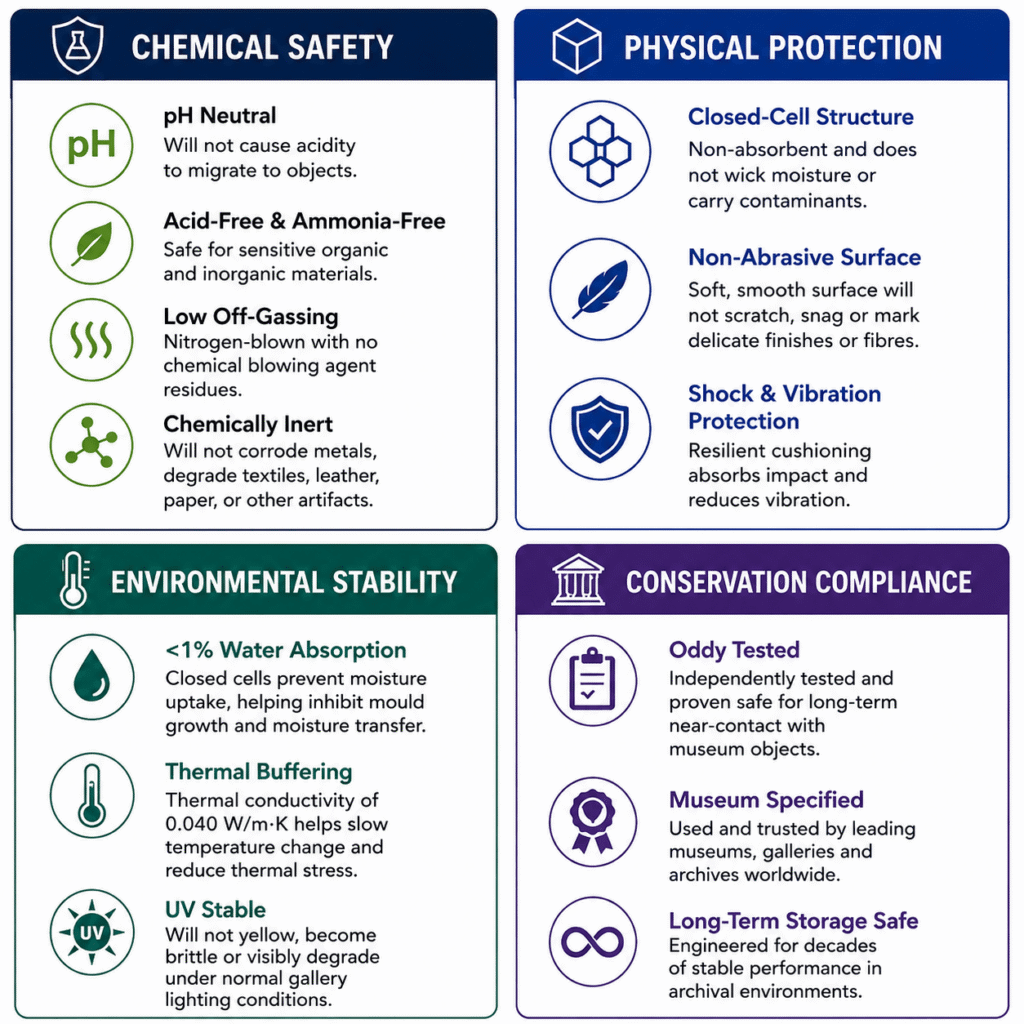
Plastazote is the museum standard closed cell foam for archival storage, display, handling and transport because it combines chemical purity, physical protection and long-term stability in one material.
Not all closed cell foam is suitable for conservation. Plastazote is specified because it is engineered for sensitive environments where materials remain in direct contact with objects for extended periods. It protects artefacts without introducing the off-gassing, acidity, moisture retention, or surface abrasion that can compromise long-term preservation.
Why Plastazote is Trusted by Museums
Plastazote is nitrogen-blown. It is expanded using high-pressure nitrogen gas rather than chemical blowing agents. That manufacturing process produces a pure closed cell foam with no chemical blowing-agent residues to cause off-gassing. For enclosed storage, display cases, archival boxes and transport inserts, purity is essential.
Plastazote is chemically inert and biologically inert. It is pH neutral, acid-free, and ammonia-free. It does not corrode metals, degrade textiles, or stain sensitive organic materials through prolonged contact. That is why it is used for mixed collections containing paper, parchment, leather, bone, ceramics, textiles and metal artefacts.
It also passes the Oddy Test for archival suitability. That makes Plastazote safe for long-term use near sensitive museum objects and establishes it as a trusted material for preventive conservation, mount-making, storage lining and exhibition support.
Its closed-cell structure is a functional advantage. Plastazote is non-absorbent, with water absorption below 1%. It does not take in ambient moisture, spills, or condensation. That prevents moisture transfer to the object, reduces the conditions that allow mould growth and supports a more stable storage environment than open-cell alternatives.
Plastazote also provides thermal buffering. With a thermal conductivity of approximately 0.040 W/m·K at a mean temperature of 10°C, it slows rapid temperature change around vulnerable objects. During handling, transport, temporary storage and display preparation, additional insulation helps reduce thermal stress. In practical museum storage, it also helps create a buffering layer against dust, vibration and short-term environmental fluctuation inside boxes, drawers and crates.
Physical protection is just as important as chemical stability. Plastazote has a non-abrasive surface, so it supports delicate finishes, fibres and edges without scratching or snagging them. Research and conservation guidance may refer to various LD grades, but in UK museum practice LD33 is frequently the preferred density because it provides the right balance of structural support and surface softness for direct-contact storage, cavity inserts and bespoke mounts.
Museum Use and Conservation Standards
Plastazote is established across museums, galleries, archives and conservation studios because it meets the material standards required for long-term object care. It is the material of choice for institutions like The British Museum, which utilises Plastazote liners in high-security cabinets for its Egyptian collection and The Victoria and Albert Museum (V&A), where it supports everything from delicate lacquered netsuke to large 15th-century artefacts. The Science Museum Group and National Museum Wales also specify Plastazote use for various specimens, such as the famous Blaschka glass models. By following the standards set by these prestigious heritage institutions, private collectors can also ensure their own archives receive the same professional-grade protection.
Plastazote is used for drawer liners, cavity inserts, storage trays, transit packaging, handling supports and bespoke display mounts because it delivers stable, repeatable performance in direct-contact applications.
The British Museum’s internal moving protocols also show how Plastazote is used beyond static storage. For small, delicate objects such as jewellery, they recommend Plastazote cut-outs to prevent items from sliding during handling and movement. For larger or heavier objects, the same protocols specify using a thick layer of Plastazote on transport trolleys, often supported by Plastazote wedges to keep objects stable during transit. This highlights the material’s role not just in storage, but also in the controlled handling and movement of artefacts.
National Museums Scotland guidance also treats pinned Plastazote as a standard packing method for robust objects in storage. In that method, stainless steel pins are used with Plastazote to hold small to medium objects securely in place on a stable foam surface. It is particularly useful when storing groups of robust items in one container; it can also be combined with secondary wrapping or small boxes where extra containment is needed.
For fitted storage, cavity inserts and bespoke mounts remain the preferred approach for more delicate or irregular forms. A well-cut insert limits movement, distributes pressure more evenly and reduces the handling needed to retrieve or repack an item.
Operational Best Practices: Display, Integration & Maintenance
Plastazote plays an important role in long-term exhibition support as well as storage. Due to its highly UV-stable structure, it will not usually yellow, become brittle, or visibly degrade under normal gallery lighting conditions. That makes it particularly suitable for multi-year exhibitions where mounts and support materials need to remain visually stable and structurally reliable over extended periods.
Ease of fabrication is also a major practical benefit in conservation settings. Plastazote is remarkably simple to cut and shape using standard tools such as a sharp utility knife, making it ideal for easy on-site customisation without needing specialised skills. For straight, clean edges, a metal ruler can be used as a guide to help avoid snagging, which is especially important when supporting delicate textiles, paper-based objects, and finished surfaces that may be vulnerable to abrasion.
The material also integrates well with other commonly specified conservation materials. It can be used seamlessly with Tyvek where a reduced-friction interface is needed, helping objects move more safely against the support surface during handling or placement. It also works well with acid-free tissue for delicate surface protection, including situations where an additional soft barrier is required between the object and the foam.
Joining & Bonding Plastazote
Plastazote also offers excellent flexibility when larger supports or layered forms are needed. Due to its thermoplastic nature, the cleanest and most professional way to join pieces is through heat bonding. A heat gun can be used to lightly soften the surfaces before pressing them together, creating a permanent, adhesive-free bond that is ideal for building up thickness or producing more complex 3D support forms from standard sheets.
For quicker assembly, specialised contact adhesives can also be used with a light layer of glue, provided they are kept away from direct contact with the artefacts themselves. This makes it easy for conservators, archivists and hobbyists to join pieces, build up thickness and create deeper inserts, stepped supports, as well as shaped structures on-site without needing specialist fabrication methods.
Maintenance is straightforward, which supports its long-term use in both storage and display environments. Due to its closed-cell structure, Plastazote can be safely vacuumed to manage dust without the material absorbing contaminants in the way open-cell alternatives may. Its long-term durability is also a key reason it remains a museum-standard material, as it is designed to provide stable physical support for decades when properly specified and used.
Foam Colour, VOCs, and Long-Term Contact
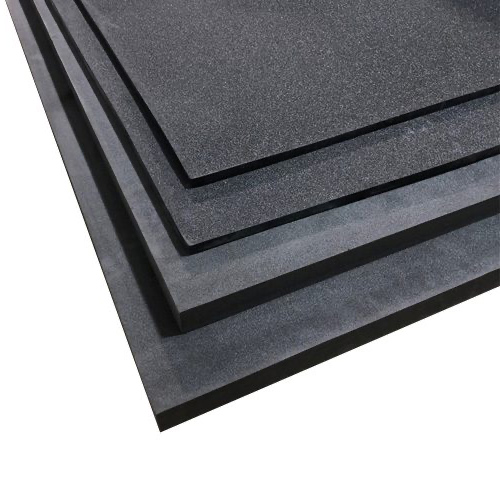
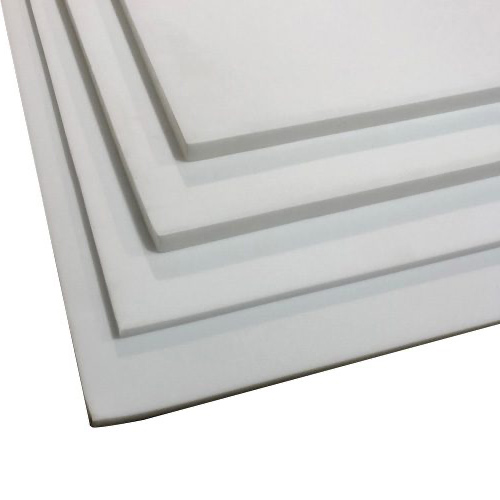
Foam selection in museums is not only about density and fit. Colour can matter as well. Recent material science research on Plastazote LD45, conducted by University of Chemistry and Technology Prague, found that white, grey and black variants all release organic acids as they age, but white foam produced substantially higher emissions than the grey and black grades.
For long-term contact with sensitive lignocellulosic materials, including paper, cardboard, and wood-pulp-based components, grey and black Plastazote variants are the safer choice. Grey performed best in the published testing, with the lowest impact on cellulosic materials, while black also outperformed white. Where prolonged direct contact is expected, especially in archival boxes and display supports, white foam should be specified with greater caution.
Archivist’s Technical Summary: Foam Specification
Below you’ll find a complete technical summary of the use of Plastazote in conservation and display applications. We’ve also included several other advice points that you may wish to take into consideration.
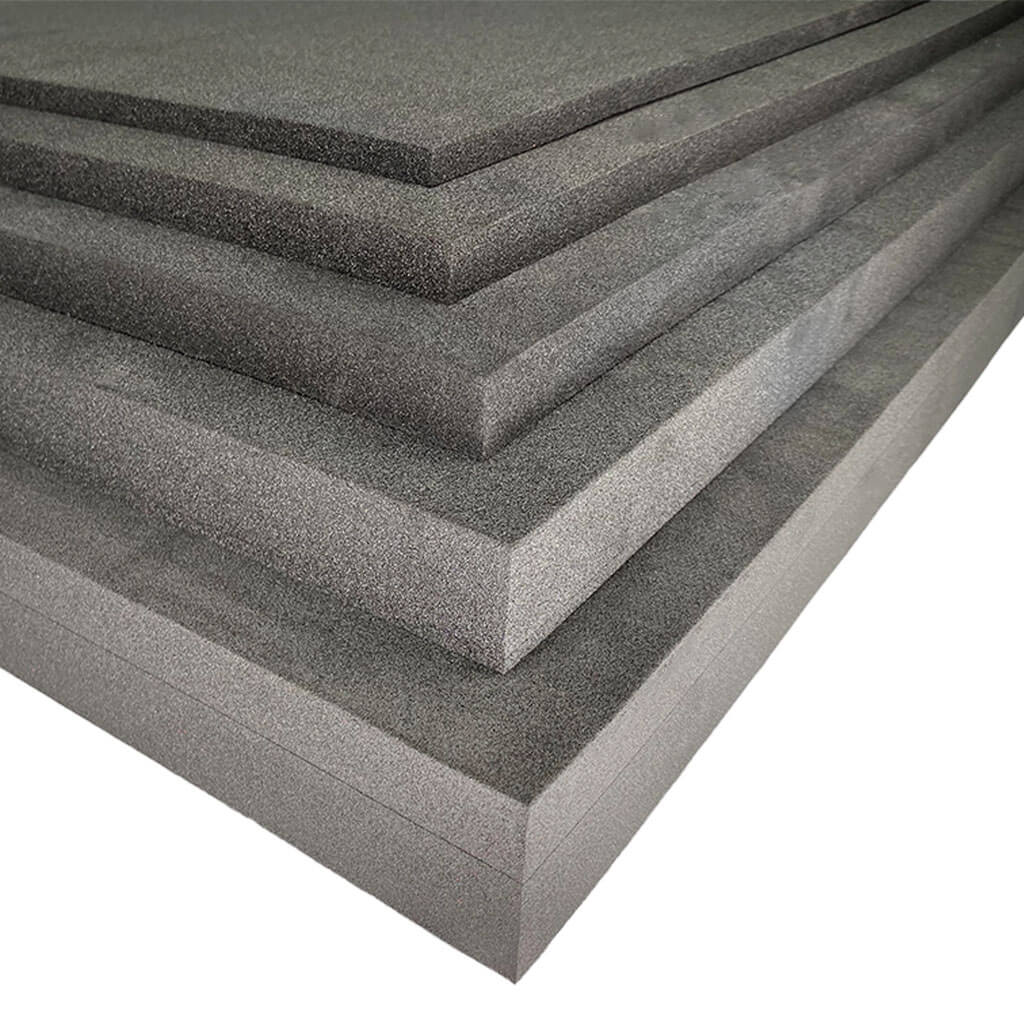
• Thickness Selection: We offer a range of Plastazote sheet thicknesses from 5mm to 50mm. 5mm-10mm sheets are great for lining drawers and trays, while thicker blocks up to 50mm are ideal for structural cavity inserts and supporting heavier objects.
• Density Layering: For complex supports, layer a soft LD33 contact surface over a firmer foam base to balance delicate cushioning with structural integrity.
• Colour Priority: Prioritise Grey Plastazote for sensitive paper-based or cellulosic materials, as it exhibits the best long-term stability and lowest emission profile in testing.
• Simple Cutting & Shaping: When hand-fabricating your own inserts from foam sheets, Plastazote is simple to cut and shape to the desired size using a sharp utility knife and a metal ruler. This straightforward approach helps produce clean, straight edges while reducing the risk of snagging on fragile textiles or loose fibres.
• Joining Techniques: Because Plastazote is a thermoplastic, pieces can be joined by lightly softening the surfaces with a heat gun and pressing them together to create an adhesive-free bond. For quicker assembly, specialised contact adhesives can also be used with a light layer of glue where they will not come into direct contact with the artefact, making it easy to join pieces, build up thickness or create more complex 3D supports from standard sheets.
Why Choose GB Foam Direct for Your Archival Projects?
GB Foam Direct brings over 50 years of foam manufacturing experience to specialist applications, including archival and museum projects. We supply Plastazote sheets backed by ISO 9001 certified quality standards, giving customers confidence in the consistency and accuracy of every order.
As a primary supplier of Plastazote, we provide the high-quality sheets required for museum-grade cavity inserts and bespoke mounts. Our material is selected for its consistency and ease of use, allowing conservators and hobbyists to hand-cut precise shapes, liners, and support pieces with confidence. While we offer precision cutting services for complex requirements, our fast next-day delivery on standard sheets ensures you have the materials you need for on-site fabrication exactly when you need them.
If you need guidance on thickness, density, the best foam for your project or anything else, our team can help specify the right foam solutions. To explore our full range of archival-safe materials, visit our dedicated Plastazote product page. For tailored advice on your project, get in touch with our team by email at sales@gbfoam.com, call 01494 441177 or use the contact form and we’ll be happy to help.

Cameron has emerged as a key marketing expert since joining GB Foam Ltd in 2017. A graduate of the University of Winchester, with a professional background in Public Relations; he has combined his content writing and brand awareness expertise with an in-depth knowledge of foam products and foam conversion technology to enhance the company’s marketing strategies and industry presence. Cameron has led numerous marketing campaigns, in both B2B and B2C segments, to further brand recognition and open up new business avenues worldwide.