




Home Cinema Acoustic Panels: Where to Put Foam in a Media Room
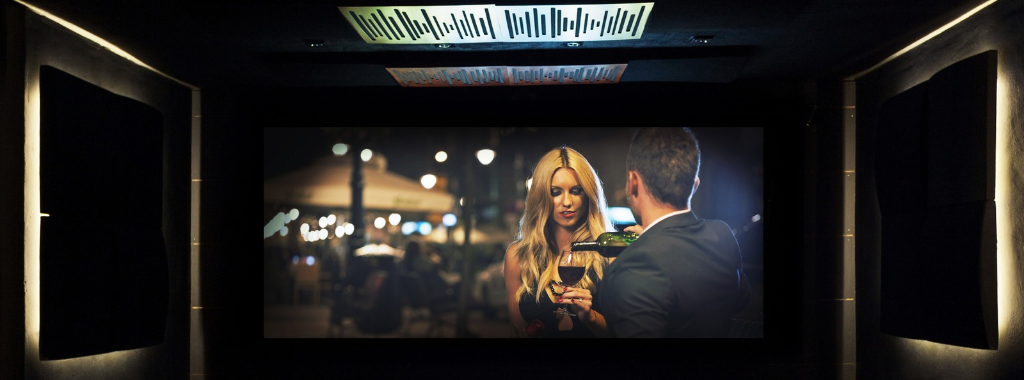
Home cinema acoustic panels are foam absorbers placed where sound from your speakers bounces back towards the seats, mainly the side walls level with the front speakers, the wall behind the seating and the room corners. Treating those points cuts echo and boom, so dialogue is clearer and bass is tighter without turning the volume up. We cut and supply acoustic tiles, bass traps and room kits from our factory in High Wycombe, ready to fit in a cinema room, snug or converted garage.
Key takeaways
- The first places to treat in a home cinema are the side wall reflection points between the front speakers and the main seats, found with the mirror method.
- Bass builds up in room corners, so a media room needs at least 4 corner bass traps before it needs more wall tiles.
- A sound that travels 1 metre further than the direct sound arrives about 3 milliseconds later, which is enough to blur dialogue.
- Our SoundFix tiles are 300mm x 300mm and 50mm thick with an NRC of 0.85, so about 11 tiles cover 1 square metre.
- Acoustic foam improves how a room sounds but does not soundproof it; stopping noise reaching other rooms needs mass and sealed construction.
- We have cut foam in High Wycombe since 1976, work to ISO 9001 and offer next working day delivery on orders placed before 11am Monday to Thursday.
What Do Home Cinema Acoustic Panels Do?
Home cinema acoustic panels absorb sound energy that would otherwise reflect off hard walls, ceilings and corners back into the listening position.
Every reflection is a slightly late copy of the original sound. Sound travels at about 343 metres per second, so a reflection that takes a path 1 metre longer than the direct sound reaches your ears about 3 milliseconds later.
Foam tiles control mid and high frequencies, such as speech and effects, while thicker bass traps in the corners deal with low frequency boom. A home cinema usually needs both. For the theory of how foam absorbs different frequencies, see our guide to everything you need to know about acoustic foam.
Why Do Home Cinemas Sound Echoey or Boomy?
Home cinemas sound echoey because most living rooms and converted spaces have parallel hard walls, a hard ceiling and few soft furnishings to absorb reflections.
Plasterboard, glass, laminate floors and bare ceilings all reflect sound well. A large television or projector screen adds another hard surface at the front of the room. Bass problems come from the room’s dimensions: low notes reinforce each other where walls meet, so some bass notes boom while others almost disappear depending on where you sit.
Where Should Acoustic Panels Go in a Home Cinema?
Acoustic panels should go first at the side wall reflection points, then on the rear wall behind the seats, then in the corners as bass traps, and finally on the ceiling above the space between the screen and the seats.
The table sets out each zone in the order we recommend treating it.
| Zone | Where Exactly | What It Fixes | Suggested Foam |
|---|---|---|---|
| Side wall reflection points | On each side wall, where a mirror shows the front left, centre and right speakers from the main seat | Blurred dialogue and vague placement of effects | SoundFix 50mm wedge tiles, or 600mm large tiles |
| Rear wall | Behind the main row of seats, at ear height | Slap echo and sound bouncing back from close behind the seats | Large wedge or pyramid tiles, 70mm to 100mm |
| Room corners | Floor to ceiling corners first, then wall to ceiling corners | Boomy, uneven bass | Wedge or pyramid bass traps |
| Ceiling | Between the screen and the seats, above the reflection point | Sound bouncing off the ceiling into the seats | Large tiles fixed with a suitable adhesive |
| Front wall | Behind and around the screen and front speakers | Reflections from the front wall and light spill around the screen | Black Class 0 self adhesive wedge tiles |
How Do You Find the First Reflection Points?
You find the first reflection points with the mirror method: sit in the main seat while a helper slides a mirror along the side wall, and mark every spot where you can see a speaker in the mirror.
The method works because sound reflects off a flat wall at the same angle it arrives, just like light. Wherever you can see a speaker’s front in the mirror, sound from that speaker is bouncing off that point to your ears. In a 5.1 or 7.1 system, check the front left, centre and right speakers on both side walls, and repeat on the ceiling with the mirror held flat.
Each reflection point needs a panel at least 600mm wide centred on the mark, which is 4 of our 300mm SoundFix tiles or a single 600mm large pyramid acoustic foam tile. Marks for neighbouring speakers often overlap, so one wider panel can cover two or three points.
How Many Acoustic Foam Tiles Does a Home Cinema Need?
Most home cinemas need 24 to 48 standard tiles plus 4 to 8 bass traps, but the right number depends on the room’s size and how many hard surfaces it has.
Our SoundFix acoustic foam tiles are 300mm x 300mm, so about 11 tiles cover 1 square metre and a pack of 24 covers about 2.2 square metres. Use the table as a starting point.
| Room | Typical Size | Wall Tiles | Bass Traps |
|---|---|---|---|
| Small snug or box room cinema | Up to 3m x 3.5m | 24 tiles | 4 |
| Lounge with a cinema setup | Around 4m x 5m | 24 to 48 tiles | 4 to 6 |
| Dedicated cinema room or garage conversion | 5m x 6m or larger | 48 to 72 tiles, or large 600mm tiles | 8 or more |
Which Acoustic Foam Should You Choose for a Home Cinema?
Choose 50mm tiles for reflection points in small rooms, thicker 70mm to 100mm large tiles for the rear wall of a larger room, and bass traps for every room size.
| Application | Recommended Foam | Why |
|---|---|---|
| Side wall reflection points | SoundFix 50mm wedge tiles, NRC 0.85 | Thin enough to sit beside seats and doorways, and absorbs speech frequencies well |
| Rear wall close behind seats | Large pyramid tiles, 70mm or 100mm | Thicker foam absorbs lower frequencies that 50mm tiles let through |
| Corners | Wedge or pyramid bass traps | Low frequencies need far more depth than a wall tile gives |
| Whole small room in one order | Acoustic treatment kit, from 24 tiles and 4 bass traps | Tiles and traps arrive matched in colour and profile |
| Behind the screen | Black Class 0 self adhesive tiles | Black foam reflects less stray light, and the tiles stick on without spray adhesive |
| Rooms where fire performance matters | Class 0 acoustic foam | Our Fireseal foam is rated Class 0 and Euroclass B-s1,d0 |
Our acoustic treatment kit comes in options from 24 tiles and 4 bass traps up to 72 tiles and 16 bass traps, which suits most cinema rooms in one order. For bass traps in depth, including corner cubes and the air gap behind a trap, read our bass traps guide.
Our acoustic foam comes in Studio Grey, Volcanic Red, Crystal Blue and black, so panels can match the room or disappear into a dark cinema scheme. Choose a wedge or pyramid profile, in 300mm x 300mm SoundFix tiles 50mm thick, 600mm x 600mm large pyramid tiles in 50mm, 70mm or 100mm thicknesses, or large wedge tiles. For the front wall, or any room where fire performance matters, our Class 0 self adhesive acoustic foam tiles are black with a wedge profile, come 24 to a pack and stick on once you peel off the backing liner.
How to Install Acoustic Foam in a Home Cinema
Install acoustic foam by marking the reflection points first, fitting the corner bass traps, then fixing tiles from the side walls back to the rear wall.
Mark the main seat. Decide where the main listening seat will be and mark it, because every reflection point is measured from that position.
Find the reflection points. Sit in the main seat while a helper slides a mirror along each side wall and the ceiling, and mark every spot where you can see a front speaker.
Fit the bass traps. Place bass traps in the floor to ceiling corners first, then add traps along the wall to ceiling corners if bass still booms.
Dry fit the side wall panels. Hold tiles over each marked point in panels at least 600mm wide and check they line up before fixing anything.
Fix the tiles. Fix tiles with a suitable spray adhesive, using contact spray adhesive for brick or carpet spray adhesive for wood, as our acoustic foam page advises.
Treat the rear wall. Cover the wall behind the seats at ear height with thicker large tiles, especially if the seats are within a metre of the wall.
Listen and adjust. Play a familiar film scene with plenty of dialogue and add tiles to the ceiling or front wall only if the sound is still harsh or echoey.
Mistakes to Avoid with Home Cinema Acoustic Foam
- Expecting foam to soundproof the room. Acoustic foam improves the sound inside the room but will not stop a film being heard in the next room or by the neighbours.
- Covering every wall with thin tiles. Too much 50mm foam soaks up treble and speech but leaves bass boom, so the room sounds dead and muddy.
- Skipping the corners. Bass builds up where walls meet, so a cinema with no bass traps will still boom whatever is on the walls.
Why Choose GB Foam Direct?
We have converted foam in High Wycombe since 1976 and supply acoustic foam in Studio Grey, Volcanic Red, Crystal Blue and black, in wedge and pyramid profiles and 300mm and 600mm tile sizes, from single packs of tiles to complete room kits. Our standard acoustic foam range is rated NRC 0.85, and our Fireseal acoustic foam and black self adhesive tiles are Class 0 for rooms where fire performance matters. We work to ISO 9001, give a 5 year guarantee against faults in manufacture, and orders placed before 11am Monday to Thursday are eligible for next working day delivery. Browse the full range on our acoustic foam page.


Speak to Our Team
If you need help choosing acoustic foam for your home cinema, call us on 01494 441177, email sales@gbfoam.com or fill out our contact form. We are in the office from 9am to 5pm Monday to Thursday and 9am to 3pm on Friday.
Home Cinema Acoustic Panels FAQs
Where should acoustic panels go in a home cinema?
Acoustic panels in a home cinema should go at the side wall reflection points first, then on the rear wall behind the seats, then in the corners as bass traps. Find the side wall points by sitting in the main seat while a helper moves a mirror along the wall and marking where each front speaker appears.
How many acoustic panels do I need for a home cinema?
Most home cinemas need 24 to 48 standard 300mm acoustic tiles and 4 to 8 bass traps. A small snug can work well with 24 tiles and 4 traps, while a dedicated cinema room or garage conversion may need 48 to 72 tiles and 8 or more traps. About 11 tiles of 300mm x 300mm cover 1 square metre.
Does acoustic foam soundproof a cinema room?
No, acoustic foam does not soundproof a cinema room. It absorbs reflections inside the room so films sound clearer, but it is too light to stop sound passing through walls, floors and doors. Soundproofing needs mass, sealed gaps and separated construction.
Do I need bass traps in a home cinema?
Yes, most home cinemas need bass traps because low frequencies build up in the corners where walls meet. Wall tiles absorb speech and effects but are too thin to control bass. Start with a trap in each of the 4 floor to ceiling corners.
What thickness of acoustic foam is best for a home cinema?
50mm tiles suit the side wall reflection points in most home cinemas, and 70mm to 100mm tiles suit the rear wall of a larger room. Thicker foam absorbs lower frequencies, but bass still needs dedicated corner bass traps.
Should I put acoustic foam behind the TV or screen?
Acoustic foam behind the TV or screen helps, but it is usually the last area to treat. Most of the improvement comes from the side wall reflection points, the rear wall and the corners. If you do treat the front wall, black foam such as our Class 0 self adhesive tiles also reflects less stray light from a projector.
How do I attach acoustic foam to the wall?
Acoustic foam is usually attached with spray adhesive: contact spray adhesive suits brick and carpet spray adhesive suits wood. Dry fit each tile first, because strong adhesive grabs straight away. Our black Class 0 self adhesive acoustic foam tiles are also available and stick without spraying.

Cameron has emerged as a key marketing expert since joining GB Foam Ltd in 2017. A graduate of the University of Winchester, with a professional background in Public Relations; he has combined his content writing and brand awareness expertise with an in-depth knowledge of foam products and foam conversion technology to enhance the company’s marketing strategies and industry presence. Cameron has led numerous marketing campaigns, in both B2B and B2C segments, to further brand recognition and open up new business avenues worldwide.